Case Study
Designing Calm, Actionable Billing Dashboards for Law Firms
Clear visual systems for surfacing financial risk without overwhelming attorneys.
Senior Product Designer | AI-assisted Workflows | Design Systems | Human-in-the-loop UX
Overview
Legal professionals, particularly those responsible for billing and client communication, work under constant time pressure where missed signals can lead to revenue loss, strained client relationships, or downstream reputation risk.
This case study explores the design of a billing and revenue dashboard for law firms, where professionals must identify when action is required, understand why, and act with confidence under tight deadlines and incomplete context.
Opportunity
If billing attorneys could clearly see when financial and communication risk was emerging and understand why it mattered, they could act earlier and more accurately before client-facing consequences occurred.
Billing attorneys need a system that:
Surfaces critical signals related to overdue balances and communication gaps: make emerging financial and relational risk visible before it escalates.
Makes urgency legible without overusing alerts or prescriptive escalation: preserve the meaning of urgency by avoiding constant or forced signals.
Compresses context from multiple sources into a single moment of attention: bring together billing status, last client contact, and timing signals when they matter most.
Reduces cognitive load during time-compressed billing periods: help attorneys reach sound judgment without requiring constant monitoring or manual synthesis.
Preserves human judgment over timing, tone, and client communication: ensure client-facing action remains explicitly human-owned, particularly where relationships and reputation are at stake.
User research and analysis of enterprise legal billing workflows revealed a gap in AI-assisted systems that could surface urgency and prepare action without over-automating decisions or assuming authority in client-facing contexts.
While grounded in law firm operations, these patterns extend to other high-stakes professional domains where acting too early can cause irreversible harm.
My Approach
Designing dashboards that make the right action clear
My approach focused on designing visual systems that help billing attorneys recognize emerging risk early and act with confidence without overwhelming them.
Rather than introducing new alerts or prescriptive automation, the design prioritized calm defaults, progressive disclosure, and clear visual hierarchy within existing workflows. AI supported action-readiness by compressing context, while visual design made urgency legible only when it mattered.
The approach followed three principles:
Let facts exist quietly until interpretation is warranted
Baseline dashboards surface accurate billing and activity data without labeling urgency by default. This preserves trust, reduces noise, and ensures attention is not diluted by constant escalation.
Introduce AI only when signals converge
AI continuously monitored objective indicators—such as overdue balances, time since last client contact, and proximity to billing close—but intervened only when multiple signals collectively crossed defined thresholds.
Prepare action without committing it
When intervention was justified, the system surfaced a single moment of attention with compressed context and a proposed draft communication. Final judgment over timing, tone, and whether to act remained explicitly human-owned.
Throughout the design, automation was treated as a way to reduce time-to-judgment, not replace professional decision-making. The system’s role was to make the right next action obvious at the right moment without escalating, sending, or implying obligation on behalf of the attorney.
Visual & System Constraints
Constraints that shaped both the visuals and the system’s behavior
Designing AI-assisted support for billing attorneys required working within constraints that directly affected how urgency, risk, and action could be communicated:
Signals carry authority
Visual emphasis, alerts, and surfaced recommendations are interpreted as guidance. But overusing urgency weakens meaning, increases cognitive load, and erodes trust in the system.Context is incomplete and probabilistic
AI can surface emerging financial and communication risk, but it operates on partial and lagging data. The interface could not imply certainty, intent, or obligation where none existed.Client-facing actions are irreversible
Once a communication is sent, intent and meaning cannot be recalled, even if the underlying signal was directionally correct.Urgency must be clear, not coercive
Time pressure was real, especially near billing close, but aggressive escalation or prescriptive language risked premature action and avoidable relational harm.
Together, these constraints shaped a system designed to surface urgency and prepare action without forcing commitment, preserving human judgment, accountability, and control at the point of decision.
Key Workflow: Orientation to Action
Dashboards guide attention instead of demanding it
High-stakes professional workflows often require balancing speed with judgment. Acting too late carries cost, but acting too early, without sufficient context, carries risk as well.
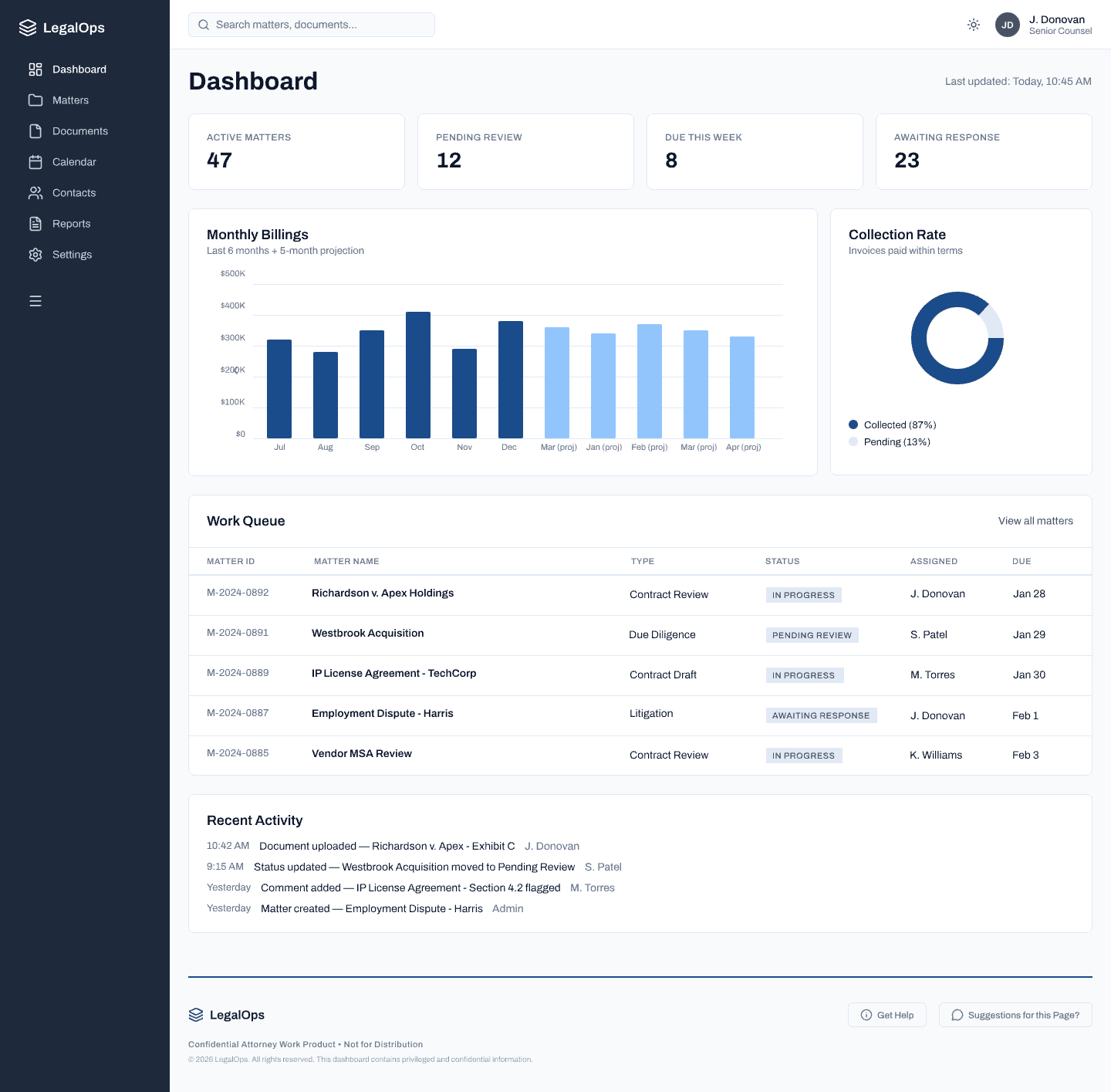
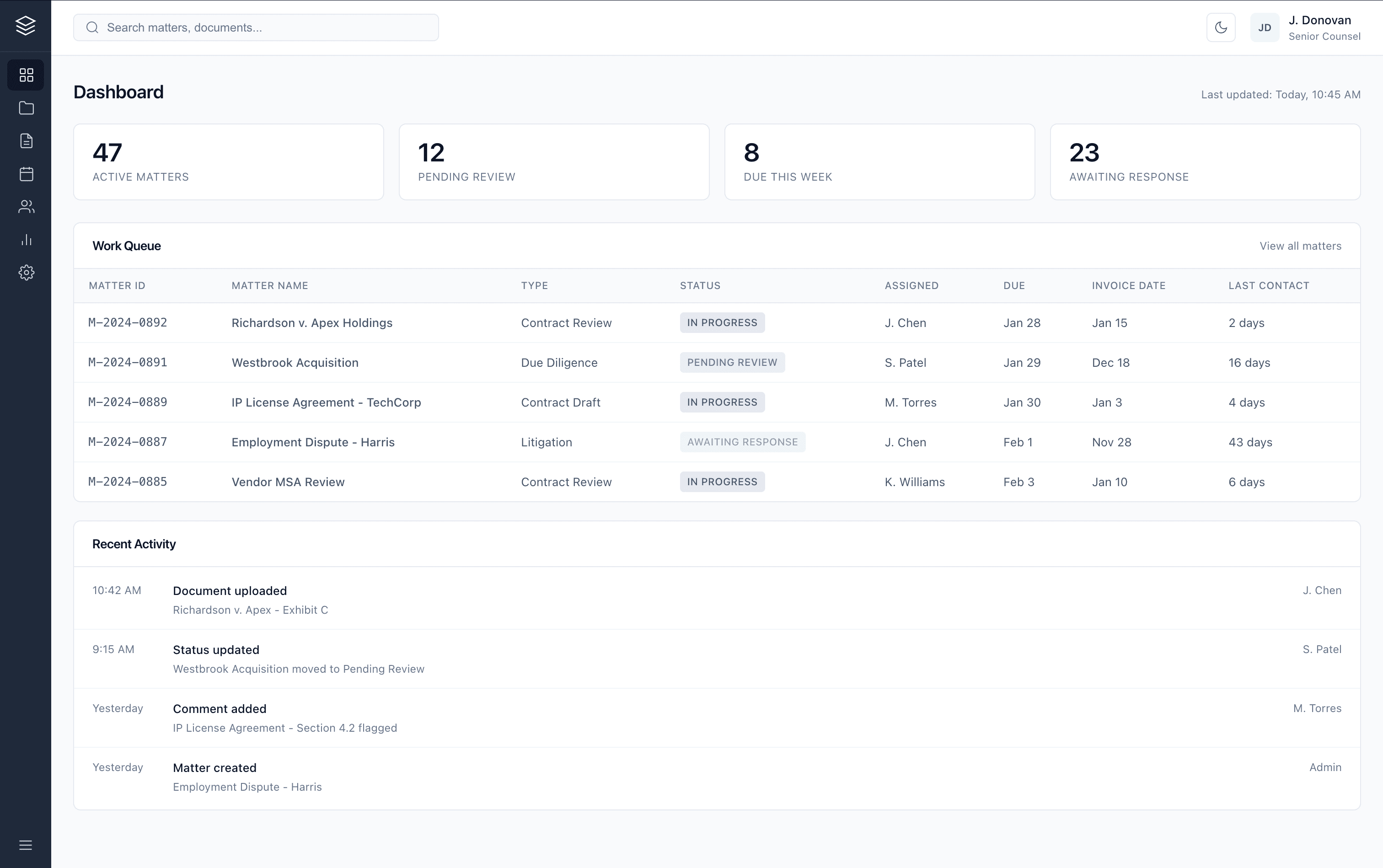
1 - Baseline Dashboard: Orientation
The home dashboard presents matters, balances, and tasks in a neutral state. No alerts fire by default, allowing users to orient themselves without distraction:
A calm overview of the billing attorney's workspace
Purpose: Establish trust and reduce cognitive noise in data-dense environments.
2 - Emerging Signals (Data Visualization)
Subtle visual indicators highlight emerging financial and communication risk, such as aging balances or extended gaps in outreach, without escalating tone or color:
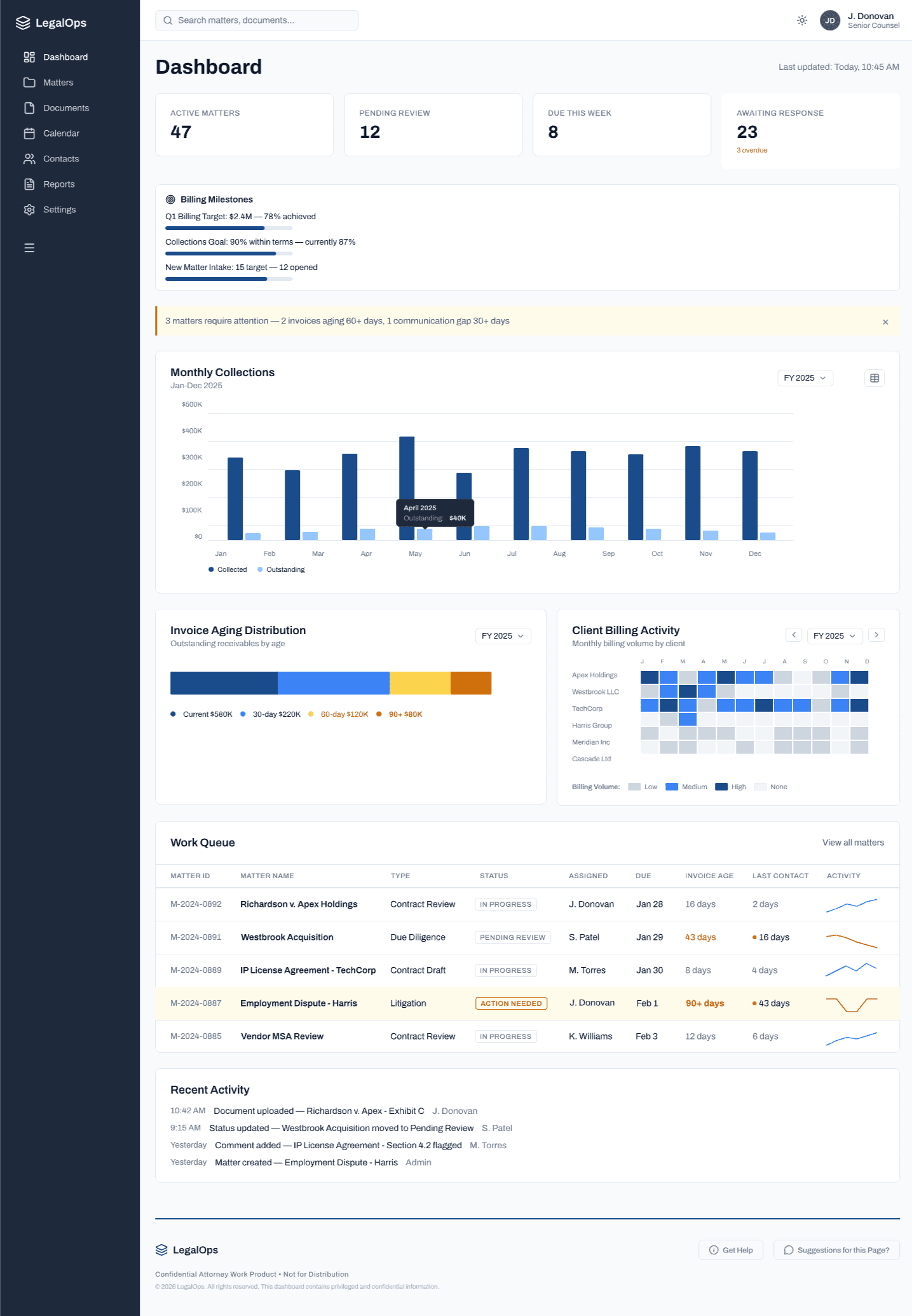
Risk becomes visible through the data itself.
Purpose: Establish trust and reduce cognitive noise in data-dense environments.
3 - Focused Context (Progressive Disclosure)
A focused panel surfaces trends, timelines, and key metrics from multiple systems in one place, reducing the need to navigate across dashboards and tables:
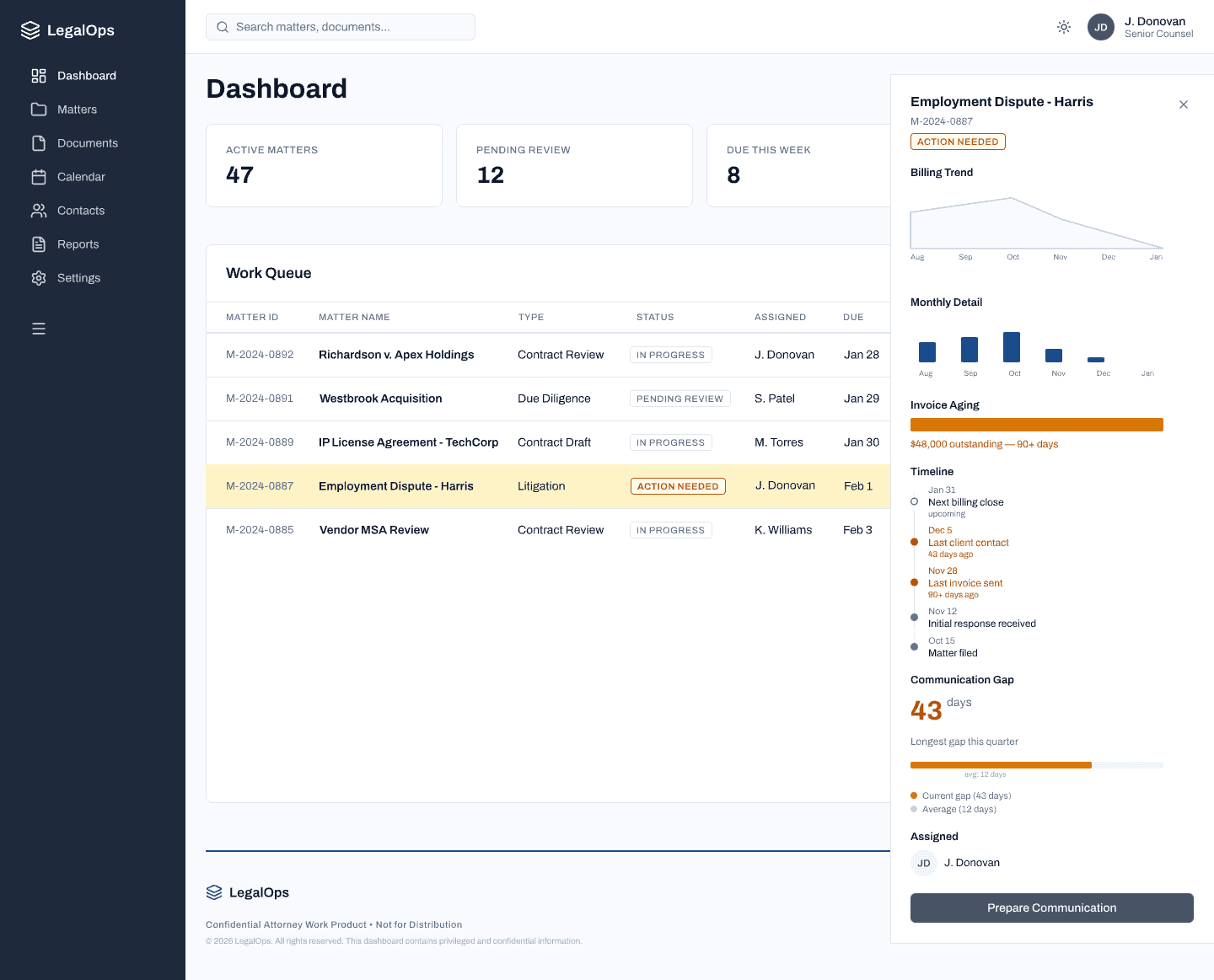
Selecting a matter reveals compressed, decision-ready context.
Purpose: Establish trust and reduce cognitive noise in data-dense environments.
4 - Action Preparation (AI-Assisted Draft)
When conditions warrant outreach, the system surfaces a draft communication with suggested language and tone. The attorney can edit, send, defer, or dismiss.
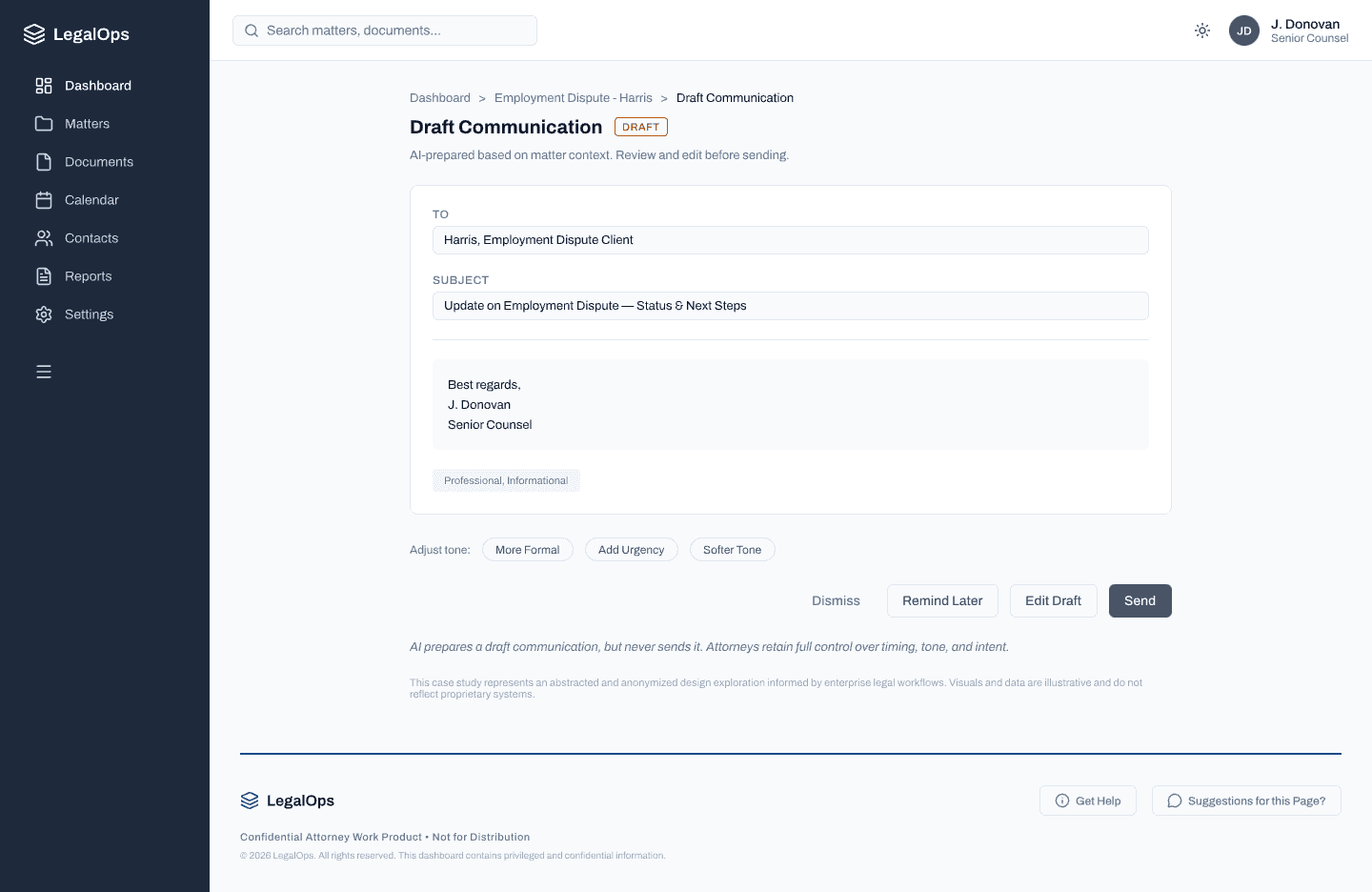
AI prepares action without committing it.
Purpose: Establish trust and reduce cognitive noise in data-dense environments.
Applied AI Decision Brief
For a deeper look at the design decisions, tradeoffs, and human-in-the-loop constraints behind this work, I drafted a decision brief that you can access here.
About Me

Hi, I’m Kirsten Duell, a Senior Product Designer specializing in visual systems and AI-assisted experiences for high-stakes domains.
I design products that turn fragmented, complex information into clear, usable context—supporting human judgment rather than replacing it. My work spans healthcare and enterprise SaaS, where timing, trust, and accountability are tightly coupled, and where visual design plays a critical role in how signals are interpreted and acted upon.
Alongside my healthcare UX work, I bring 10+ years of experience designing end-to-end, enterprise-grade SaaS products, including AI-assisted platforms that secured seed funding and long-term service contracts. I’ve led visual and product design for complex data systems, shaped human-in-the-loop AI workflows, and partnered closely with product and engineering teams to deliver solutions that scale responsibly.
With a background in medical product development at Abbott Laboratories and UC Irvine, and certification in HIPAA compliance, I’m experienced designing within regulated environments. I view compliance not as a limitation, but as a core design input—one that sharpens clarity, responsibility, and system integrity.
I’m also comfortable working close to implementation, having front-end engineered products and collaborated directly in code environments when needed.
Outside of work, I enjoy studying longitudinal data from health metrics and wearable data to skiing performance and sleep patterns, as a way to better understand how systems, feedback loops, and behavior evolve over time.
Thank you for taking the time to review my work. I enjoy connecting with thoughtful product and design leaders and discussing how careful, human-centered design can reduce cognitive burden, preserve trust, and improve outcomes in complex systems.